This past Sunday morning during church choir practice I went off about pockets.
Not the music; not the anthem we were not ready for. Pockets. Another woman had said something in passing about hers, or the lack of them, and that was all the invitation I needed. What I actually said out loud was: “That is how the patriarchy keeps us down.” And then, because I heard myself, “Women, that is.”
I said it with my whole heart. The one comment was an opening, and instead of edging away from me, they got this look. The good look. One of them said I should preach about it.
I am not going to preach about it. I am not clergy, and our actual priest does not need me freelancing from the choir loft. But a blog, I can do.
We had pockets. Then someone took them.
Here’s the thing that irks me. Women did not always live like this. For a long stretch of history, pockets were just something everyone had. They were often tie-on pouches you wore under your skirts and reached through a slit, big enough to haul around whatever you needed for the day. Keys, coins, snacks, a small book, probably a flask. I do not know your business.
This isn’t just me theorizing in the choir loft: there is actual scholarship on the topic. Barbara Burman and Ariane Fennetaux wrote a whole book about the tie-on pocket, “The Pocket: A Hidden History of Women’s Lives,” tracing what women from duchesses to washerwomen carried with them and what those pockets meant for their work, their money, and their freedom to move around. The inventory of what showed up in them runs from cake to stolen ribbon to, in at least one case, two live ducks.
Then fashion changed. Skirts got narrow, the silhouette got slim, and those roomy pockets ruined the line. So they went away. Women got handed a tiny decorative bag instead, just big enough to be utterly useless, and then we were told this was an upgrade.
Men’s clothing went the other way. Sewn-in pockets, lots of them, and nobody ever took them away. A men’s suit is basically a storage system with a person inside it. Jacket, pants, the little chest one, the secret inside one. They are swimming in pockets.
Funny how the gender that got to keep its hands free is also the one that historically got to, you know do things.
This is not a vibe. Someone measured it.
If you think I am being dramatic, two data journalists at The Pudding actually went and measured it. Eighty pairs of jeans, twenty brands, men’s against women’s, same waist size. Women’s front pockets came out 48 percent shorter and about 6 percent narrower. Roughly half the pocket, for no reason anyone can defend. Most of them too shallow to hold a phone without it tipping out the second you sit down.
And then there is the fake pocket. The stitched-on lie. You see the seam, you go for it with real hope in your heart, and your fingers hit a wall. That is a special kind of insult. Someone intentionally designed a pocket-shaped decoration so the garment could look functional while being the opposite of functional. I have a whole professional opinion about things that are built to look like they work instead of actually working, but that is a different post.
It was never really about the pockets.
This isn’t a small thing, even though it sounds like one.
A pocket means you can carry your own stuff. Your keys, your money, your phone. On your body, hands free, no extra equipment required. No bag to remember, no bag to buy, no bag to set down in a public place and then pray about.
Take pockets away and you have quietly built in a dependency. Now you need a purse. The purse costs money. It is one more thing to track, one more thing that can get lost or stolen, one more hand that is not free. Multiply that across an entire gender for a couple hundred years and it stops looking like a fashion quirk.
Independence is a small physical thing before it is ever a big abstract one. It is being able to walk out the door with everything you need and nothing you have to hold.
And the historians keep landing on the same point: a pocket is private. It sits against your body, hands free, nobody’s business. A purse is public. It can be searched, grabbed, handed off, set down, lost. When you only get the purse, you do not just lose storage. You lose a private space of your own, one nobody else gets to reach into.
That’s the other half of the insult. On the rare occasion women’s clothes do include a pocket now, it is shallow, often fake, and almost never private the way a man’s has always been. We get the shape of the thing without the use of it. History is full of that move. Hand someone the outline of a right or a freedom or a pocket, keep the working version for yourself, and call it equal. This one just happens to be easy to point at, because you can stick your hand in it and feel the wall.
Even the robes.
Standing in the narthex getting ready to process in, it hit me again. A choir robe usually has one good pocket and a slit cut into the side. The slit is not the pocket. The slit is so you can reach through the robe to the real pocket underneath, in your trousers, the ones men are wearing. The whole garment is designed around the assumption that you already have a pocket.
Reach through that slit in most women’s clothes and you find your own leg. Nothing else. The vestment is more honest about pockets than the clothes most of the women under it are wearing.
So there I was, complaining about the pocketless state of women’s clothing while wearing a robe that quietly assumed I had pockets I did not have, holding my phone and my cough drops in my hand like a raccoon.
Maybe that is the actual sermon. The thing keeping you slightly off balance is usually small, old, and so normal that nobody questions it anymore. You just adjust around it. You buy the bag. You hold the cough drops.
Or you say something about it at choir practice and make everyone a little uncomfortable.
I recommend the second one.
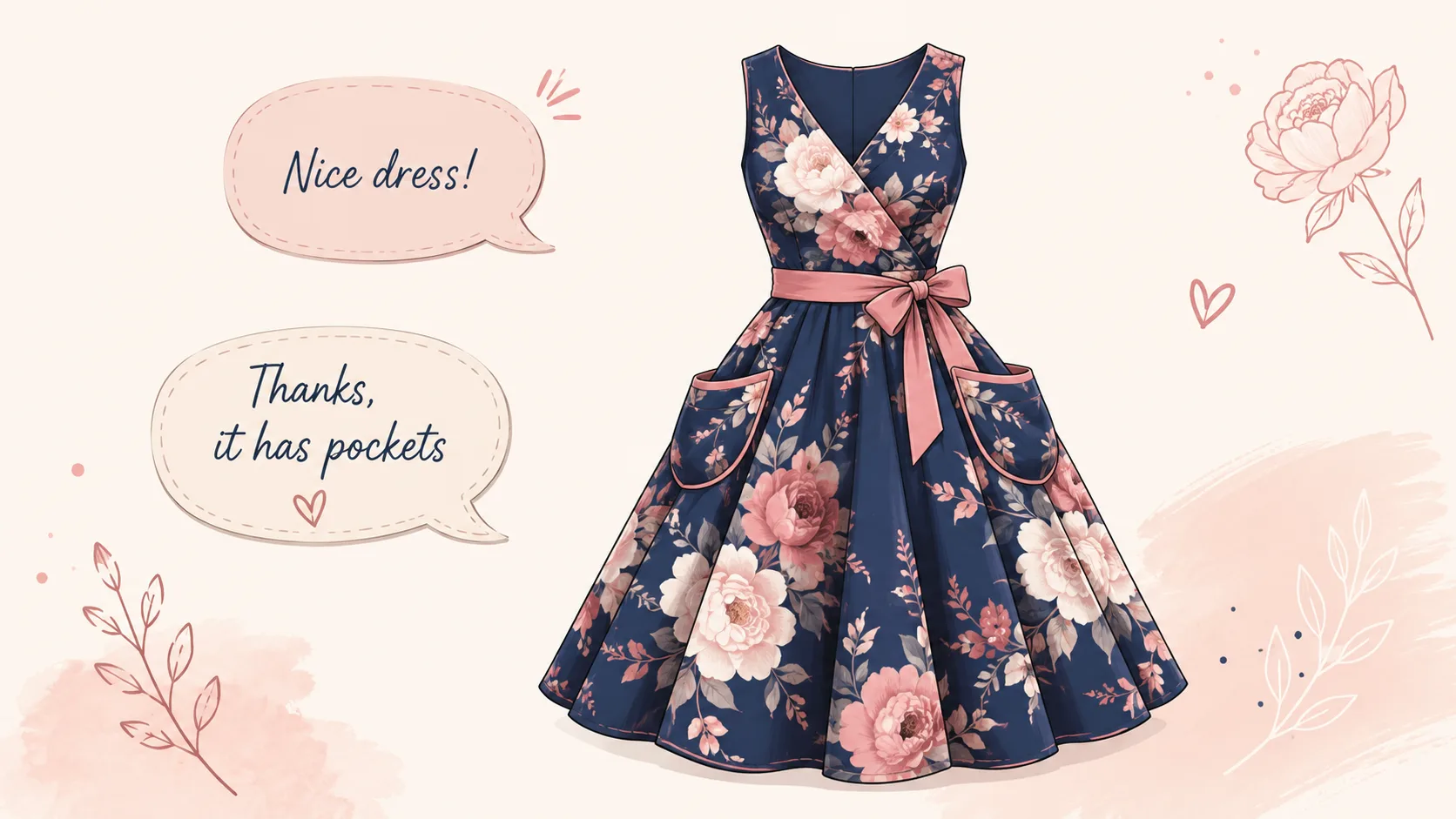
This, by the way, is why you can compliment a woman on her dress and get back a slightly unhinged “thanks, it has pockets!” Not thanks. Not thank you, I like it too. Thanks, it has pockets, said with the joy of someone who found a twenty in an old coat. The garment could be gorgeous. Does not matter. The pockets are the headline. That is how rare they are. We throw a small parade when they show up.
So, to the people who design women’s clothing: give us the pockets back. Real ones. Deep enough for a phone and a sense of self-determination.
If you want the receipts: Barbara Burman and Ariane Fennetaux, “The Pocket: A Hidden History of Women’s Lives, 1660–1900” (Yale University Press); Hannah Carlson, “Pockets: An Intimate History of How We Keep Things Close” (Algonquin); and the pocket measurements from Jan Diehm and Amber Thomas at The Pudding, “Women’s Pockets Are Inferior.”