The short version: CVSS scores alone can’t tell you what to fix first. You need context: Is this asset internet-facing? Does it hold sensitive data? Is there an active exploit? Combine vulnerability data with asset criticality and threat intelligence. Fix the things that would actually hurt you, not just the things with high numbers.
Your vulnerability scanner just finished its weekly run.
10,000 findings. 3,500 marked “critical.” 2,000 marked “high.”
Your SIEM dashboard shows 500 alerts from last night. All flagged as critical.
The business wants three security projects done this quarter. All top priority.
Your team has capacity for maybe one.
So what do you actually fix first?
The Priority Paralysis Problem
I see this in every program I walk into.
Everything is critical. Everything is urgent. Everything needs to be done yesterday.
The vulnerability management backlog goes back months. The SIEM alerts pile up faster than anyone can review them. Security projects get half-started and never finished because the next “critical” thing shows up.
And here’s what actually happens: nothing gets fixed.
Your team spins. Leadership gets frustrated. The actual critical stuff sits in a queue with 10,000 other “critical” things.
When everything is critical, nothing is.
How We Got Here
The tools made it worse.
Vulnerability scanners rely on CVSS scores that measure theoretical severity in a vacuum. A 9.8 on a system nobody can reach gets the same “critical” label as a 7.2 on your internet-facing authentication server. The scanner can’t tell the difference.
SIEM platforms alert on everything because missing something is worse than flooding you with noise. Better to cry wolf 10,000 times than miss one real threat.
Framework assessments mark every control as important because that’s what the framework says. Nobody wants to be the standard that said something wasn’t critical.
Result: everything gets labeled critical. Everything gets flagged urgent.
Now add the business side: every stakeholder thinks their project is critical. Every compliance requirement is non-negotiable. Every customer question needs immediate attention.
Your capacity doesn’t scale with the noise. So you’re stuck.
What Actually Matters
Here’s what I learned managing vulnerability programs and security operations: you need a filter that cuts through the noise.
Not another scoring system. Not another framework. A filter based on one question:
Does fixing this actually decrease the likelihood of something bad happening to us?
Not theoretical risk. Not CVSS scores. Not what the framework says.
What attack that’s hitting organizations like yours does this prevent?
That’s what matters. Everything else is noise.
The Filter
Is it being exploited in the wild?
CISA Known Exploited Vulnerabilities. Actual incidents at peer organizations. Real attacks, not theoretical ones.
If it’s on the KEV list, it goes to the top. If attackers are actively using it, you patch it.
Everything else waits.
Can it be reached from the internet?
Internal vulnerability on a system with no external access? Lower priority.
Same vulnerability on your internet-facing application? Top of the list.
Exposure matters more than severity scores.
Does it access data you actually care about?
Critical vulnerability on a system that touches customer data or financial information? Priority.
Same vulnerability on an isolated test environment? It can wait.
Not all systems are equal. Protect what matters.
What’s the actual exploit complexity?
Requires physical access and three preconditions? Lower priority.
Click a link and you’re compromised? That’s urgent.
Likelihood matters as much as impact.
What’s the business impact if this goes wrong?
Vulnerability that could take down revenue-generating systems? Top priority.
Issue on an internal tool used by three people? It can wait.
Business impact drives priority, not CVSS scores.
Making It Work
This filter won’t give you a perfect priority list. It’ll give you a defensible one.
And here’s the thing about defensible: you can explain it. To your team. To leadership. To auditors.
“We prioritize based on active exploitation, exposure, data sensitivity, exploit complexity, and business impact. Here’s why we fixed these 100 things instead of chasing 10,000.”
That’s a conversation you can have.
“Our scanner said it was critical” is not.
The Hard Part
The hard part isn’t the filter. It’s saying no.
No to the 9,000 vulnerabilities that don’t meet your criteria. No to the SIEM alerts that are noise. No to the security project that sounds good but doesn’t reduce actual risk.
Every no feels risky. What if you’re wrong? What if that’s the thing that matters?
But here’s the reality: you can’t do everything. Trying to do everything means nothing gets done well.
You have to choose. Make it a choice based on actual risk, not noise.
What This Looks Like
Your vulnerability backlog is 10,000 items. You apply the filter:
- 50 are on CISA KEV
- 200 are internet-facing with high exploit probability
- 300 touch sensitive data
- Everything else waits
You now have 550 things to fix. Still a lot. But it’s a start.
You work the list. You fix the 50 KEV items first. Then you work through the internet-facing stuff. Then the data access issues.
Three months later, your backlog is still 9,000+ items. But the 550 that actually mattered? Done.
That’s progress.
The Same Logic Everywhere
This isn’t just for vulnerabilities.
SIEM alerts? Same filter. Does this indicate actual malicious activity or is it noise?
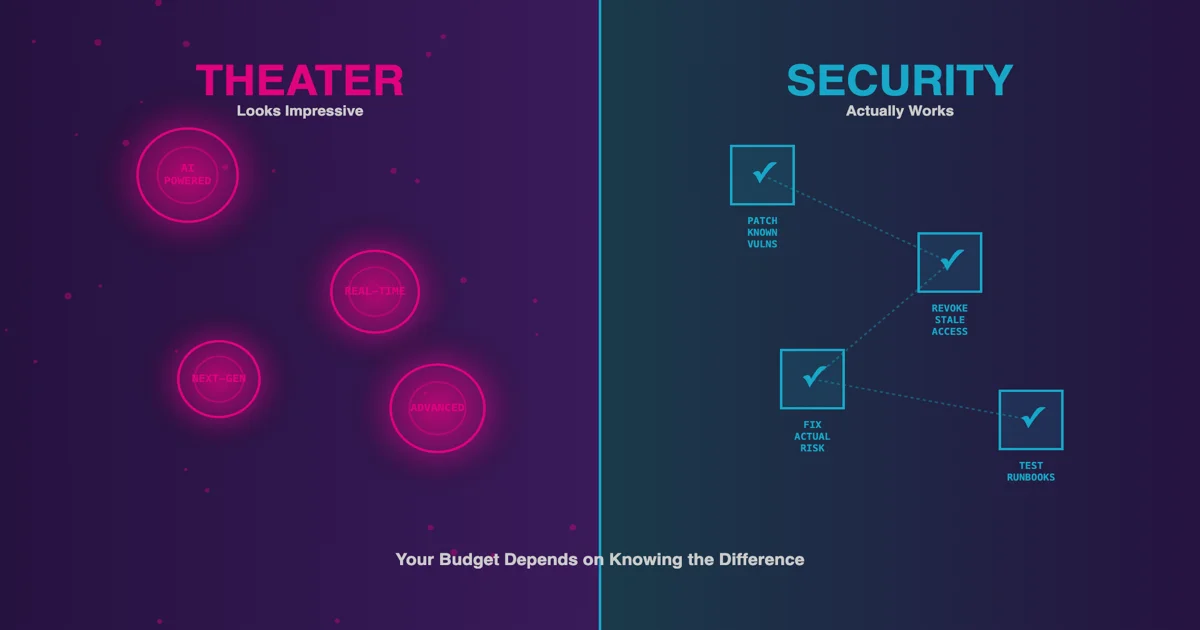
Security projects? Same filter. Does this reduce the likelihood of something bad happening? Read our guide on avoiding security theater to focus on what actually matters.
Compliance requirements? Same filter. Does this control actually reduce risk or just check a box? Our SOC 2 guide separates the essentials from the theater.
When everything screams for attention, you need a way to cut through the noise.
Business impact. Active exploitation. Exposure. Data sensitivity. Exploit complexity.
That’s your filter.
The Bottom Line
You will never fix everything.
Your vulnerability backlog will always have items in it. Your SIEM will always have alerts. Your project list will always be longer than your capacity.
That’s reality.
What you can control: what you choose to fix first.
Make it the stuff that actually matters. The things that reduce real risk. The issues that attackers are exploiting right now.
Let everything else wait.
Because when everything is critical, you have to choose what’s actually critical.
And that choice needs to be based on risk, not noise.
If your team is stuck in the “everything is on fire” cycle and needs someone to help prioritize, that’s a core part of what I do as a fractional CISO.
Need help prioritizing your security program? Get our free Startup Security Kit with practical checklists and templates to help you focus on what actually matters. Or explore all our free cybersecurity resources.
Struggling with priority paralysis in your security program? Need help building a filter that actually works? Virtual CISO services provide strategic security leadership to help you prioritize what actually reduces risk.
Not sure if you need security leadership? Read our guide on when you actually need a CISO.