The short version: You probably need security leadership if investors, customers, or contracts are asking security questions you can’t answer. A fractional CISO costs $3K-15K/month and makes sense when you need expertise but can’t justify $300K+ for a full-time hire.
Someone mentioned hiring a CISO. Or a customer asked about your security program. Or an investor brought it up in diligence.
Now you’re wondering if you actually need one.
Here’s how to tell.
Signs You Actually Need Security Leadership
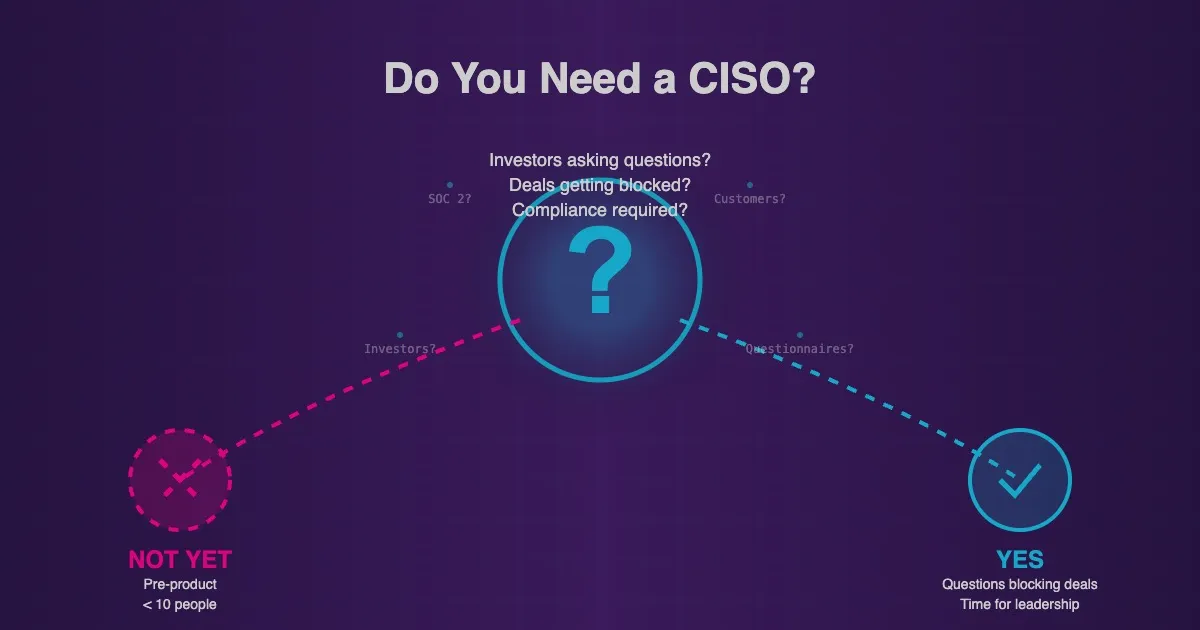
Investors are asking questions you can’t answer
“What’s your incident response plan?” “How do you handle vendor security?” “Walk me through your security roadmap.”
If you’re fumbling, that’s a sign.
Enterprise customers want proof Security questionnaires. Policies. SOC 2 reports. Can’t answer? You’re not closing enterprise deals.
Compliance showed up in a contract SOC 2. PCI DSS. HIPAA. If it’s in the contract, it’s not optional.
You hit 10-50 people and lost track
Who has access to what? What happens when someone leaves? How do you vet vendors?
If the answer is “good question,” you’ve got a problem.
Something almost broke
Phishing email almost worked. Vendor got compromised. Customer data almost leaked. That “almost” won’t last forever.
Signs You Probably Don’t Need One Yet
You might not need security leadership if:
- You’re pre-product and bootstrapped
- You have fewer than 10 people
- No one’s asking about your security
- Security questions aren’t blocking deals
Don’t overcomplicate early. You can add this later.
If You’re Vibe Coding and Ignoring Security
You’re shipping fast. Security feels like overhead. No one’s asking about it yet.
Here’s the problem: by the time someone asks, you’ve already built the mess.
Things that will bite you later:
- Hardcoded API keys in your repo (yes, even the private one)
- Everyone on the team has admin access to everything
- No idea what data you’re actually storing or where
- That vendor integration you added because it was easy
- Production access through someone’s personal Google account
You can ignore security early. But fixing it later means rebuilding stuff you thought was done.
You can vibe code. We can help you stay out of trouble.
What Your Options Look Like
Starter session: 2-hour working session. Figure out what matters at your stage. Get a checklist, playbook, and your top 3 priorities.
Advisory work: Weekly calls and email support for gut-checks on security decisions. Good for early-stage founders who need answers on demand.
Foundation building: Set up security basics. Policies, processes, vendor reviews. Makes sense 6-12 months out from compliance.
Compliance prep: Active SOC 2 or other framework work. Readiness, control implementation, customer calls, audit prep.
Full-time hire: Post-Series B, 100+ employees, or security blocking multiple deals quarterly. Now you need someone at $200K-400K annually.
Most startups benefit from fractional CISO services until they hit the scale where full-time makes sense.
What Good Security Leadership Actually Does
Tells you what matters now vs. later. Helps you spend money where it counts. Gets you ready to answer customer and investor questions. Builds what you need without overbuilding.
Watch out for consultants who push products they’re partnered with, create policies no one will read, or ignore your budget and stage.
The Bottom Line
You need security leadership when people are asking questions you can’t answer, deals are getting blocked, or compliance is non-negotiable.
You don’t need it when no one’s asking yet or you’re still figuring out product-market fit.
And when you do need it, you’ve got options before committing to a full-time hire.
Ready to Talk?
Not sure which category you’re in? Let’s talk. Consulting services are delivered through Vaughn Cyber Group.